Continuing the journey backwards through time, my collection reaches the reign of George II. This coin represents a significant leap in age compared to the Victorian and William IV pieces previously showcased. We are now in the mid-1700s, an era when the Royal Mint was plagued by a unique problem: counterfeiting.
During this period, official copper coins were often melted down or hoarded, while lightweight fakes flooded the market. Finding a genuine official issue from this era, like this one, is a satisfying tick in the “Type Set” checklist.
The Historical Context: The “Old Head”
George II reigned for a long time (1727–1760). As a result, his coinage is divided into “Young Head” and “Old Head” issues.
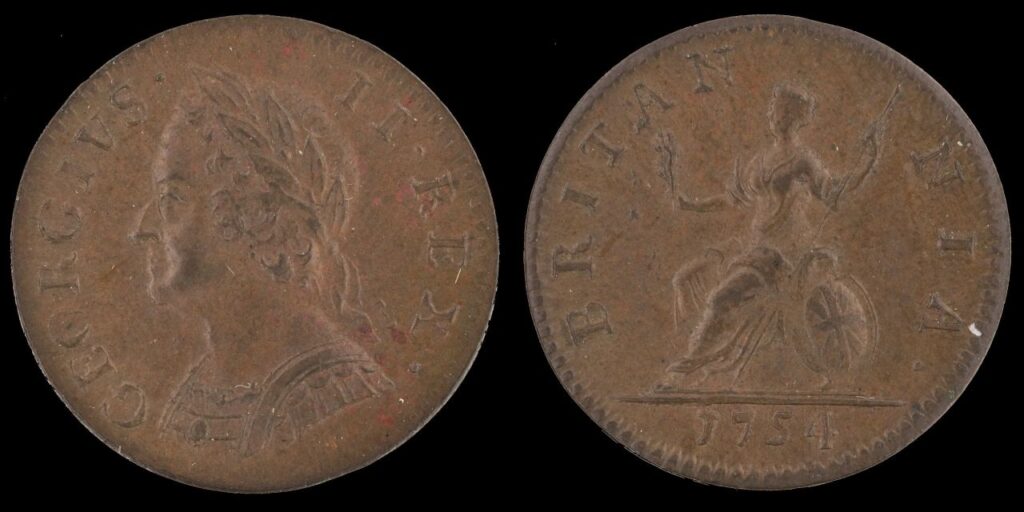
This coin, dated 1754, features the “Old Head” portrait. By this time, the King was in his 70s. The portrait was engraved by the legendary John Croker (one of the Mint’s greatest talents), capturing the aging monarch with a distinct laurel wreath and cuirassed bust.
The Coin: 1754 George II Farthing
- Denomination: Farthing (¼ Penny)
- Monarch: George II (Old Head)
- Year: 1754
- Metal: Copper
- Designer: John Croker (Obverse)
- Reference: Spink 3722
The Design:
The obverse legend reads GEORGIVS II REX (King George II). The reverse displays Britannia, seated, holding a spray of leaves and a spear, with the date in the exergue below.
Condition & Grading
Grading coins from the 1750s requires a different set of expectations than grading coins from the 1890s. Copper from this period was often less pure, leading to different aging patterns.
The Assessment:
- Obverse: The King’s portrait is visible but worn. The high points of the face are flat, though the outline of the “Old Head” profile is unmistakable. The legend is clear.
- Reverse: Britannia is distinct, though she has lost the finer details of her drapery and shield.
- Surface: The coin possesses a dark, matte chocolate tone. You will notice some pitting and surface roughness (porosity), as well as some reddish deposits in the crevices (around the lettering). This is very common for copper that has been in the ground or stored in humid conditions over 270 years.
Grade: Fine (F)
In the US grading market, this would likely be graded as VG 10 or F 12 due to the surface porosity.
The Verdict
While this coin shows the scars of its age—surface pitting and honest wear—it is a remarkable survivor. Think of the history this small piece of copper has witnessed. It was struck the same year the French and Indian War began in North America. To hold a coin from the 1750s is to hold a direct link to the pre-industrial world.
Further Reading & Data: