Leaving the round milled coins of Europe behind, we travel East to the isolationist world of Edo-period Japan.
For the Western collector, Japanese coinage from the 19th century is often a shock. It isn’t round, it doesn’t feature a portrait of a ruler, and it doesn’t have a date in Western numerals. Instead, it is a rectangular tablet of silver, defined by beautiful calligraphy and the crest of the Mint. This specific coin is an Ichibu-gin (One Bu Silver) from the Tenpō Era.
The Historical Context: The Tokugawa System
Before Japan opened to the West in the 1850s and 60s, it used a complex monetary system based on rice, gold, silver, and copper.
The base unit was the gold Ryo (the famous oval Koban coin). The system worked in multiples of four:
- 4 Shu = 1 Bu
- 4 Bu = 1 Ryo
Therefore, this silver rectangular coin was worth exactly one-quarter of a gold Koban. It represents the height of the domestic commerce system just before Commodore Perry’s “Black Ships” arrived and changed Japan forever.
The Coin: Tenpō Ichibu-gin (1837–1854)
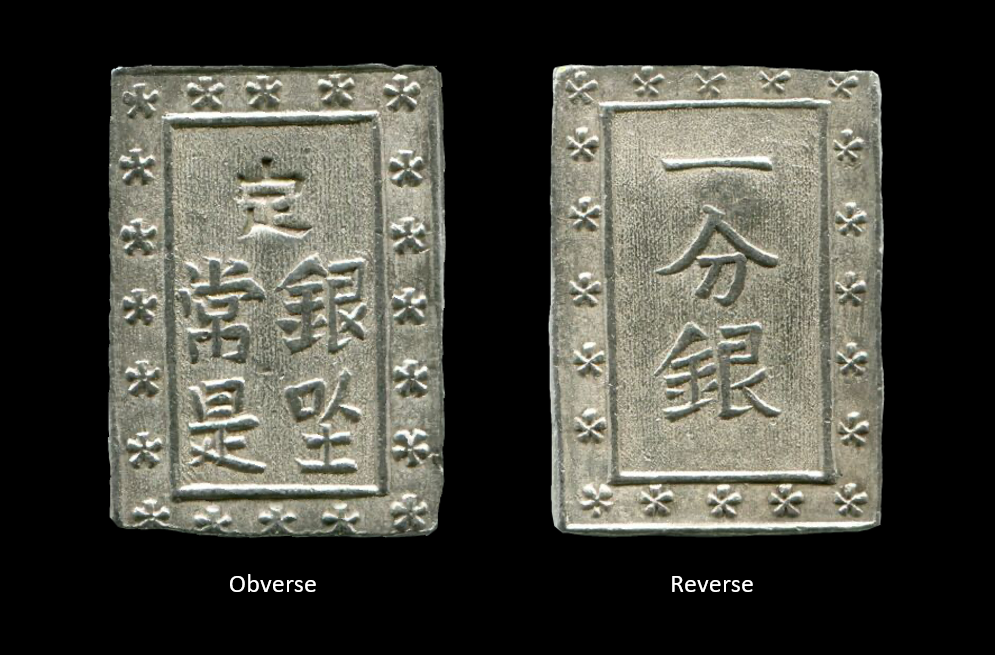
- Denomination: Ichibu-gin (1 Bu Silver)
- Era: Tenpō (1837–1854)
- Metal: Silver (.991 fineness)
- Mint: The Ginza (Silver Mint), Edo (Tokyo)
- Reference: Hartill 9.90 / JNDA 09-51
Deciphering the Calligraphy:
- Obverse (Left Image):
- Top: A stylised mint control mark (Modified ‘Jo’).
- Middle: 銀座 (Ginza) – “Silver Mint.” (Yes, the famous shopping district in Tokyo is named after the mint that produced this coin).
- Bottom: 常是 (Joze) – The hereditary name of the Mint Official.
- Reverse (Right Image):
- Top: 一 (Ichi) – “One.”
- Bottom: 分銀 (Bu Gin) – “Bu Silver.”
- The Border: A distinct frame of cherry blossoms (Sakura). On Tenpō era coins, the cherry blossoms on the reverse are usually inverted (upside down) relative to the obverse.
Condition & Grading
Grading Japanese rectangular coins is different from Western coins. We don’t look for “wear on the ear” because there is no portrait. Instead, we look for the sharpness of the kanji characters and the texture of the fields.
The Assessment:
- Strike: The calligraphy is razor-sharp. The strokes in “Ginza” and “Joze” are deep and clear.
- Surface: The fields are bright and lustrous. Many of these coins have dark, heavy toning, but this example is “white,” suggesting it was either stored carefully or professionally dipped in the past. It presents beautifully.
- Absence of Damage: Crucially, this coin lacks “chopmarks.” In this era, merchants would often hammer their own small stamps into coins to verify the silver content. A “chop-marked” coin is considered damaged. This example is pristine.
Grade: Extremely Fine (EF) to Uncirculated
The freshness of the silver and the lack of circulation marks on the high points of the border suggest this coin saw very little actual commerce.
The Verdict
The Tenpō Ichibu-gin is a masterpiece of design. It feels heavy and substantial in the hand—real money. It is a relic of the “Old Japan”—minted by Shoguns in Edo, used by Samurai and merchants, just years before the Meiji Restoration would sweep this entire currency system into the history books.
Further Reading & Data: