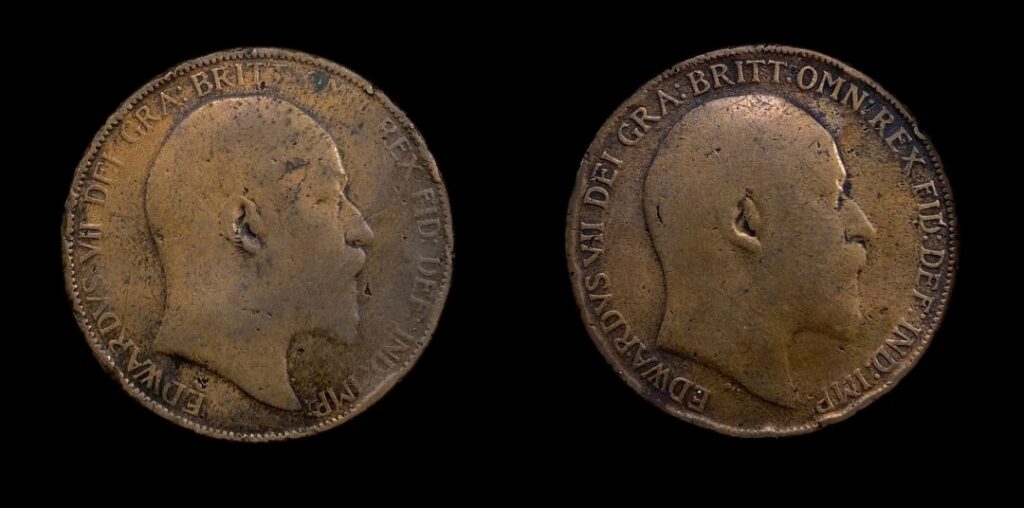
Every collection needs a curiosity—something that makes you look twice. At first glance, this looks like a standard penny of Edward VII. But if you flip it over, you are greeted by the King’s face… again.
This is not a rare error from the Royal Mint. It is a piece of “Post-Mint Damage” (PMD) with a mischievous purpose. It is a classic Magician’s Coin, engineered to ensure the owner never loses a coin toss.
The Construction: A skilled fabrication
This item was created by taking two genuine Edward VII pennies and skillfully machining them.
- Method: Usually, one coin is shaved down to a thin “shell,” and the other is ground down to fit inside it. Alternatively, both are ground flat and soldered together.
- The Seam: As noted in the description, the join is just visible around the rim. This is the tell-tale sign of a manufactured trick coin. If this were a genuine mint error (known as a “Brockage”), the image on one side would be incuse (sunken and reversed). Here, both portraits are raised and facing the correct way, proving it was man-made.
The Coin(s): Edward VII Penny (c. 1902–1910)
- Type: Novelty / Trick Coin
- Monarch: Edward VII
- Host Coins: Two Bronze Pennies
- Dates: Hidden forever (sandwiched in the middle!)
- Designer: G.W. de Saulles
The “Bald King”:
The host coins feature the classic profile of Edward VII. He was the first British monarch to be depicted without a crown on domestic coinage since the time of Charles II, leading to the nickname the “Bald King.”
Condition & Grading
You cannot grade this coin on the Sheldon scale because, technically, it is a destroyed coin. However, we can judge the craftsmanship.
The Assessment:
- The Join: The fact that the seam is visible but subtle suggests a competent machinist or jeweller did the work.
- The Surfaces: The coins used were clearly circulated before they were joined. There is distinct wear on the King’s hair and beard on both sides. The colour is a consistent, dull bronze, suggesting the alteration happened a long time ago—perhaps contemporary to the Edwardian era or shortly after.
Classification: Altered / Novelty Item
The Verdict
While a purist might call this a “fake,” I view it as a piece of social history. It wasn’t made to deceive a shopkeeper; it was made to deceive a friend at a bar. It is a tactile reminder of the lighter side of numismatics. It sits in my collection not as a specimen of the Royal Mint, but as a specimen of human ingenuity (and perhaps a bit of dishonesty!).