Following the bronze 5-cent piece, I am adding a higher denomination from the same region: the 50 Cents (or Half Shilling) of British East Africa.
While the previous coin featured elephant tusks, this one showcases the other apex symbol of the African savannah: the Lion. It is a stunning piece of engraving that captures the landscape of the region perfectly.
The Historical Context: Wartime Silver
This coin is dated 1942, slap-bang in the middle of World War II.
What makes this coin numismatically interesting is its composition. By 1942, the British Empire was running low on silver, which was needed for the war effort and to pay debts to the USA.
- In the UK, silver coins were reduced from .925 (Sterling) to .500 purity.
- In East Africa, they went even lower. This coin is .250 Silver (25% silver, 75% copper/nickel). It was the final era of silver coinage in East Africa before they switched to copper-nickel in 1944.
The Coin: 1942 East Africa 50 Cents
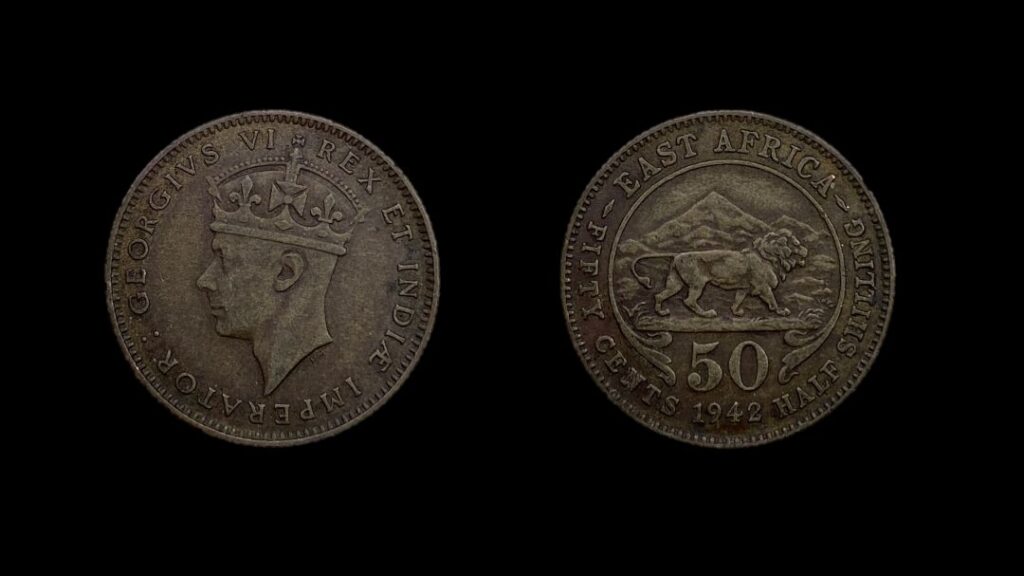
- Denomination: 50 Cents / Half Shilling
- Monarch: George VI (Crowned Head)
- Year: 1942
- Metal: .250 Silver
- Mint: Royal Mint, London (likely)
- Reference: KM 28.1
The Design:
This is the feature that draws most collectors in.
- Reverse: A magnificent African Lion walking to the right. In the background, the jagged peaks of a mountain are visible—interpreted variously as Mount Kenya or Mount Kilimanjaro. It evokes the vastness of the East African landscape in a way few other coins do.
- Obverse: The crowned bust of George VI. Note that he is wearing the Imperial Crown (unlike British domestic coins where the King is bare-headed). This was standard for colonial issues.
A Note on the Mint:
Unlike my previous East African piece, this coin does not bear the “H” mintmark, indicating it was likely struck at the Royal Mint in London.
However, according to James Sweeny’s History of the Birmingham Mint, Heaton was heavily involved in producing this issue. They struck over 6 million of these 50-cent pieces, sometimes striking coins dated ‘1942’ well into 1943 to meet wartime demand. While this specific example is a London product, its Heaton-minted cousins were circulating alongside it.
Condition & Grading
The Assessment:
- Obverse: The King’s portrait is handsome, though there is wear on the high points of the cheek and the jewels in the crown.
- Reverse: The lion is the star here. The musculature is still visible, though the mane has lost some definition. The mountains in the background remain distinct.
- Surface: The coin has a dark, gunmetal grey tone. This is characteristic of low-grade (.250) silver. Because the copper content is so high (75%), these coins don’t tone to a bright white/blue like sterling silver; instead, they darken to a charcoal colour.
Grade: Very Fine (VF)
A lovely, honest example of a wartime silver issue.
The Verdict
This coin represents the end of an era. Two years later, the silver would be gone, replaced by base metal. It pairs beautifully with the 1937 Bronze—together, they show the Tusk and the Lion, the two great symbols of the East African protectorates.
Further Reading & Data: