We have traveled from the modern milled coins of the 20th century, past the hammered copper of Charles II, all the way back to the Early Medieval period.
This coin was minted roughly 300 years before the Battle of Hastings. It belongs to a fascinating series known as Sceattas (singular: Sceat). These were the first true silver pennies of England, circulating during the reigns of the early Anglo-Saxon kings like Ine of Wessex or Offa of Mercia (though Sceattas rarely bear a King’s name).
The Historical Context: Abstract Art
If you look at this coin and think “that doesn’t look like a person,” you aren’t alone. Unlike the realistic portraits of the Romans, Anglo-Saxon art was abstract and symbolic.
The imagery is often described as “Celtic” or “Teutonic.” It relies on patterns, curves, and stick figures. This was the era of Beowulf and the Sutton Hoo treasure. The coin reflects that world: mysterious, slightly pagan, and utterly distinct from the classical world.
The Coin: Secondary Phase Silver Sceat (c. 710–760)
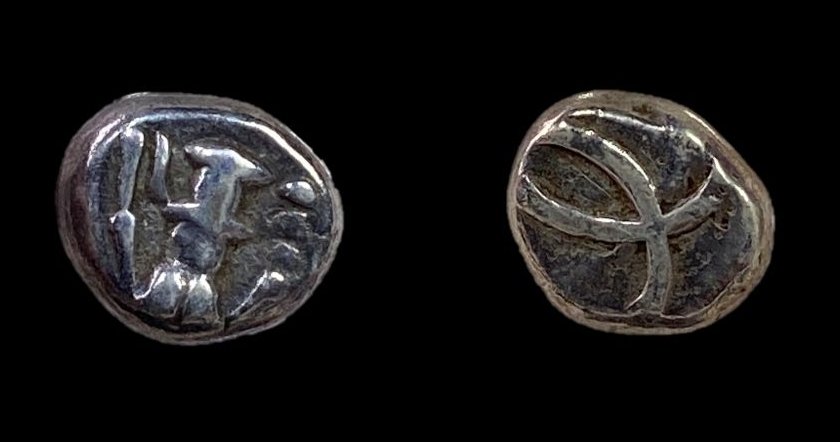
- Denomination: Sceat (Early Penny)
- Period: Secondary Phase (Series N or similar derivative)
- Date: c. 710–760 AD
- Metal: Silver
- Reference: Spink 806-812 var.
The Design:
- Obverse (Left Image): This appears to be the “Standing Figure” type. You can make out a stylized figure standing, holding a long cross or staff in each hand (creating a ‘W’ shape with the arms). It is effectively a “matchstick man” King or Bishop.
- Reverse (Right Image): This is highly stylized, but it appears to be the “Monster in Flight” or a geometric whorl. The curved lines represent the beast’s body and limbs, dissolved into an abstract pattern.
Condition & Grading
Grading a Sceat is very different from grading a milled coin. We don’t look for “wear” in the modern sense; we look for the quality of the silver and the clarity of the symbols.
The Assessment:
- The Flan: The coin is small, thick, and irregular (“dumpy”). This is perfectly normal. Sceattas were not cut from sheets of metal; they were pellets of silver hammered between dies.
- The Strike: The figure on the obverse is surprisingly centered and distinct. The crosses are visible.
- The Metal: The silver is dark and toned, which is excellent. Bright white Sceattas have often been chemically cleaned, stripping away their history. This one looks like it was found in the earth.
Grade: Very Fine (VF)
For a coin that is 1,250 years old, the details are remarkable. The main motifs are clear and the coin is sound.
The Verdict
This is the oldest piece in my collection uploaded so far. When this coin was minted, Vikings had not yet raided Lindisfarne. England was a patchwork of warring kingdoms (Wessex, Mercia, Northumbria). To hold this is to hold a piece of the foundational history of Britain.
Further Reading & Data:
- The Fitzwilliam Museum: Early Medieval Corpus (The ultimate database for Sceattas)