In the early 19th century, Birmingham was the beating heart of Britain’s industrial and metal‑working world. When official copper coinage ran desperately short, it was Birmingham’s private manufacturers who stepped in to keep the economy functioning. This 1812 Penny Token from the Union Copper Company is a perfect example of that ingenuity — a locally issued, fully circulating substitute for government money during one of the most turbulent monetary shortages in British history.
These tokens weren’t curiosities. They were real money in the pockets of workers, merchants, and factory owners across the Midlands. For a collector with Birmingham roots, this piece is more than exonumia — it’s a direct link to the city’s industrial identity.
The Historical Context: The Great Copper Shortage (1811–1812)
By 1811, Britain’s official copper coinage was in crisis. The Royal Mint could not keep up with demand, and the Napoleonic Wars strained metal supplies. Into this vacuum stepped Birmingham’s private mints — firms like Boulton & Watt, Heaton, and the Union Copper Company — producing high‑quality copper tokens that circulated widely and were accepted as de facto currency.
The Union Copper Company was one of several Birmingham manufacturers that issued tokens redeemable in cash or notes. Their 1812 Penny is among the most recognisable, featuring the iconic handshake motif symbolising trust, partnership, and commercial reliability — values essential in a period when the public had to rely on private enterprise for everyday money.
The Token Details
- Denomination: 1 Penny Token
- Issuer: Union Copper Company
- Date: 1812
- Metal: Copper
- Mint/Origin: Birmingham, England
- Reference: Dalton & Hamer (Warwickshire) 28; Withers 1100 (commonly cited)
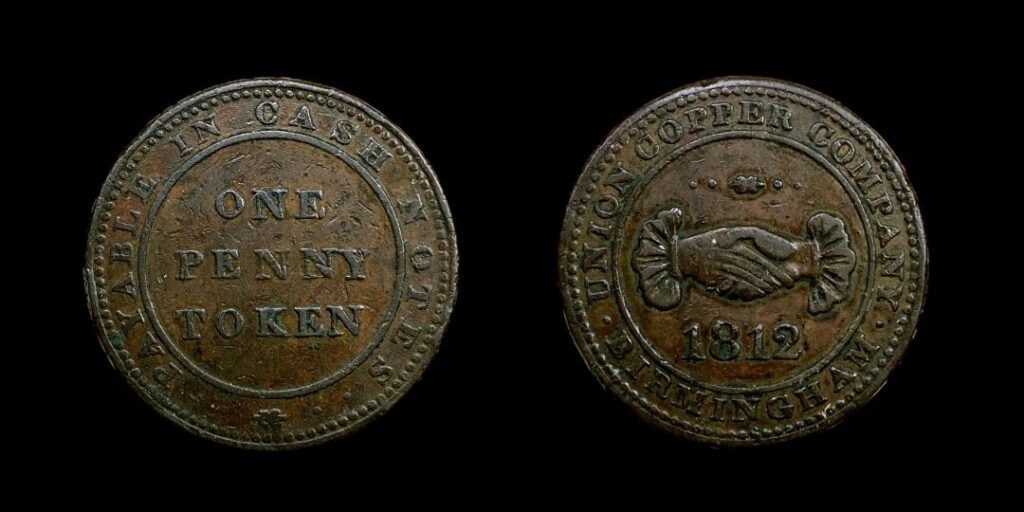
Obverse: PAYABLE IN CASH NOTES surrounding the central inscription ONE PENNY TOKEN.
Reverse: UNION COPPER COMPANY BIRMINGHAM encircling two clasped hands above the date 1812.
The handshake design is one of the most enduring symbols of the Birmingham token series — a visual guarantee of honesty and redemption at the issuer’s premises.
Condition & Grading
This example shows the typical circulation wear expected of a token that genuinely served as currency during the shortage years.
- Surfaces: Even brown tone with honest wear across the high points.
- Legends: Fully readable on both sides, including the issuer’s name and the PAYABLE legend.
- Design: The handshake remains clear, though softened by circulation.
- Overall Grade: Fine to Good Fine
- US Equivalent: F12–F15
A solid, problem‑free example — exactly the kind of circulated token that tells the story of its era.
The Verdict
For a Birmingham‑connected collection, this token is essential. It represents the city at its industrial peak, solving national problems with local innovation. While the Royal Mint struggled, Birmingham’s metalworkers kept commerce alive — and this Penny Token is a tangible reminder of that civic resilience.
It also fits beautifully into a broader narrative of pre‑decimal currency, private enterprise, and the Midlands’ role in shaping Britain’s monetary history. A perfect addition to your exonumia section and a natural companion to your Heaton‑related pieces.
Further Reading
- Numista entry for Union Copper Company Penny Token (1812)
- Galata — Union Copper Company Penny Token (1812)
- Coincraft — Union Copper Company One Penny Token (1812)