As part of the project to update my collection and seek out examples for a “Type Set”, I am starting with one of the most iconic designs in British numismatics: the Victorian “Bun Head” Penny.
This specific piece is not just a beautiful portrait; it represents a massive industrial shift in how Britain made money.
The Historical Context: The Great Recoinage
For nearly a century prior to this coin, British pennies were made of heavy, soft copper (think of the massive “Cartwheel” pennies of George III). By 1860, the Mint faced a problem: the old copper coins were too heavy, smelled of metal when warm, and were easily damaged.
In 1860, the Royal Mint switched to Bronze (an alloy of copper, tin, and zinc). These new coins were smaller, harder, and more durable. This coin is from that very first year of issue, making it the inaugural date of a series that would last until Decimalisation in 1971.
The Coin: 1860 “Beaded Border” Penny
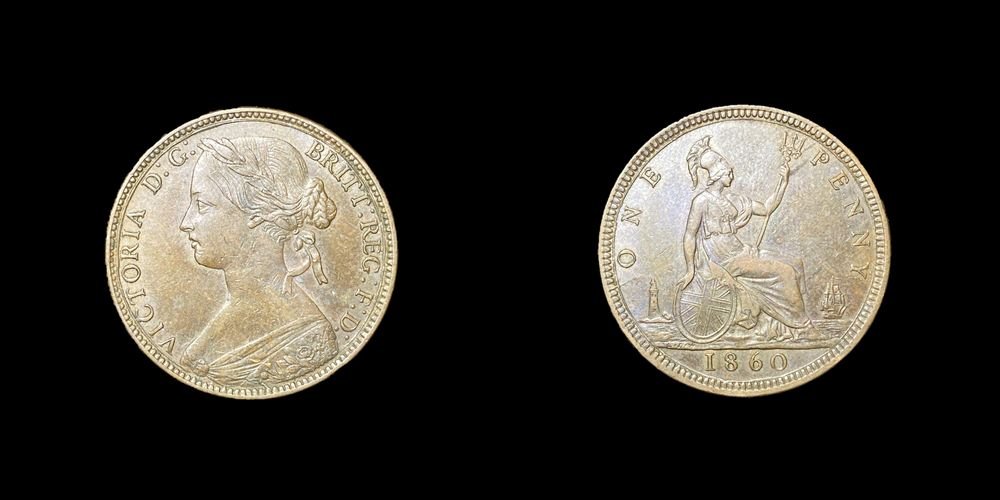
- Denomination: One Penny (1d)
- Monarch: Victoria (Young Head / Bun Head)
- Year: 1860
- Metal: Bronze
- Reference: Spink 3954
The Variety:
A keen eye will notice a specific detail on this coin. In 1860, the Mint experimented with the design. This example features the Beaded Border (distinct circular dots around the rim). Later in 1860, this was changed to “toothed” denticles, which became the standard for the next century. The Beaded Border is the earlier, and scarcer, variety.
Condition & Grading
Collecting bronze is a challenge. The metal is hard, meaning dies often broke or failed to strike the details fully. Furthermore, bronze reacts to the environment, often turning a dark, muddy brown over time.
The Assessment:
This example is in exceptional preservation. The key to grading the “Bun Head” is the Queen’s hair. On a worn coin, the plait becomes a single smooth blob. Here, the individual strands of the hair and the leaves of the laurel wreath are distinctly separated. The eyebrow—a high point usually the first to vanish—is sharp.
The reverse is equally strong. Britannia’s shield, which often wears flat, retains the distinct lines of the Union Jack, and the lighthouse and ship in the background are clear.
Grade: Good Extremely Fine (GEF)
In the US grading market, this would likely sit between AU 58 and MS 62.
The Verdict
For a Type Collection, the goal is to find a coin that perfectly represents the era. An 1860 Beaded Border, with this level of detail and light, brassy toning, is a textbook example of Victorian artistry. It captures the optimism of the mid-19th century and the peak of the Wyon family’s engraving skill.
Further Reading & Data: