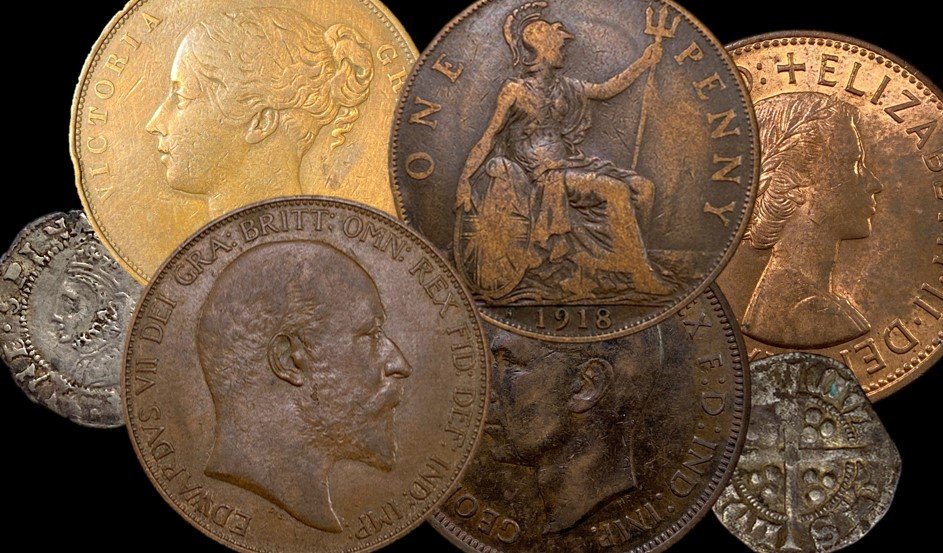
One of the first things a collector learns is that condition is king. However, “condition” is not a single, static standard. The way we judge a machine-made milled Crown from 1847 differs vastly from how we assess a hammered Penny of Edward I, or indeed a cast bronze Tenpō Tsūhō from Edo-period Japan.
As a collector focusing primarily on English coins, tokens, 19th-century Japanese issues, world coins minted by the Heaton Mint, Birmingham, and “fakes”, I grade my collection based on the physical state of the coin itself, not the plastic holder it sits in. However, to help you navigate the wider market, this guide covers the traditional UK descriptive standards for Milled and Hammered coins, as well as the US-based numerical “Sheldon” scale you will often encounter.
1. Modern Milled Coins (c. 1662 – Present)
Machine-struck with a collar, resulting in a uniform round shape and consistent details.
For milled coins, grading is primarily a measure of wear—the removal of metal from the highest points of the design due to circulation.
- Proof: Technically a method of manufacture, not a grade. These are struck on specially prepared polished blanks with polished dies, often twice or more, to ensure a razor-sharp strike and mirror-like fields. Note: An “Impaired Proof” is one that has seen circulation.
- Brilliant Uncirculated (BU) / FDC: A coin with full mint lustre and no signs of wear. “FDC” (Fleur de Coin) implies absolute perfection, while BU is a standard marketing term for a lustrous, unworn coin.
- Uncirculated (UNC): The coin shows no wear relative to its strike. It may have “bag marks” (small contact nicks from clashing with other coins in mint bags) or uneven toning, but the high points retain their original mint bloom.
- Extremely Fine (EF): A lovely grade. The coin retains much of its original mint lustre. There is only the slightest wear on the very highest points (e.g., the King’s eyebrow or the tips of Britannia’s shield), visible only upon close inspection.
- Very Fine (VF): The coin has seen circulation. The high points show distinct flattening, and the lustre may be gone from the open fields, though it often remains protected amongst the lettering. All major details are sharp and clear.
- Fine (F): A heavily circulated coin. High points are worn flat, and smaller details (like hair strands or shield lines) may have merged. However, the legend and date are clear and bold.
- Poor / Fair: The lowest grades. The design is worn almost smooth; the date or monarch may be barely identifiable. These are usually only collectible if the coin is extremely rare, or if you want a filler or placeholder.
2. Earlier Hammered Coins (Pre-1662)
Struck by hand using a hammer and dies, often resulting in irregular shapes.
Grading hammered coins is an art form. Unlike milled coins, these were not uniform when they left the mint. A hammered coin can be “Uncirculated” in terms of wear but still look “weak” due to a poor strike. When grading these, we look for a combination of preservation and strike quality.
- The “VF” Standard: For many hammered issues, Very Fine (VF) is an exceptional grade. It implies the coin is well-struck, round, and has minimal wear.
- Strike vs. Wear: A coin might have a flat portrait not because of wear, but because the moneyer didn’t hit the die hard enough (weak strike) or the metal didn’t flow properly.
- Ghosting: You may see the faint outline of the reverse cross appearing on the obverse portrait. This is common on thin medieval pennies and does not necessarily lower the grade, though it may affect the eye appeal.
- Clipping: Is the edge irregular? “Clipping” (where silver was shaved off by thieves in history) is damage, whereas an “irregular flan” is a manufacturing trait.
Expert Note: This nuance also applies to 19th-century Japanese rectangular coinage (like the Ichibu Gin). A weak corner on a rectangular coin is often a result of the minting process, not circulation wear.
3. The “Slabbed” Standard (The Sheldon Scale)
The US-based numerical system often used by Third-Party Graders (TPG). I personally do not collect these.
While I prefer the tactile history of a raw coin, the market frequently uses “slabs” (hard plastic holders). These use the Sheldon Scale, a 1-70 numbering system. For completeness, here is how they roughly align with the UK terms:
- MS 60 – MS 70 (Mint State): equivalent to UNC / BU.
- MS 70 is theoretically flawless.
- MS 60–62 are Uncirculated but may be ugly, heavily bag-marked, or weakly struck.
- AU 50 – AU 58 (About Uncirculated): equivalent to Good EF / A-UNC.
- AU 58 is often a “slider”—a coin that looks UNC but has a whisper of friction.
- XF 40 – XF 45 (Extremely Fine): equivalent to Good VF / EF.
- Note: US “XF” standards are often looser than strict British “EF”. A US XF40 might only be a British Good VF.
- VF 20 – VF 35 (Very Fine): equivalent to Fine / Good Fine / VF.
- F 12 – F 15 (Fine): equivalent to VG (Very Good) / Fine.
A Final Word on Eye Appeal
A technical grade does not always capture a coin’s beauty. A “Fine” hammered groat with rich, dark old toning is often more desirable than a “VF” example that has been scrubbed bright and shiny. When in doubt, trust your eye—or feel free to ask someone.